
November ballot may include big changes at City Hall
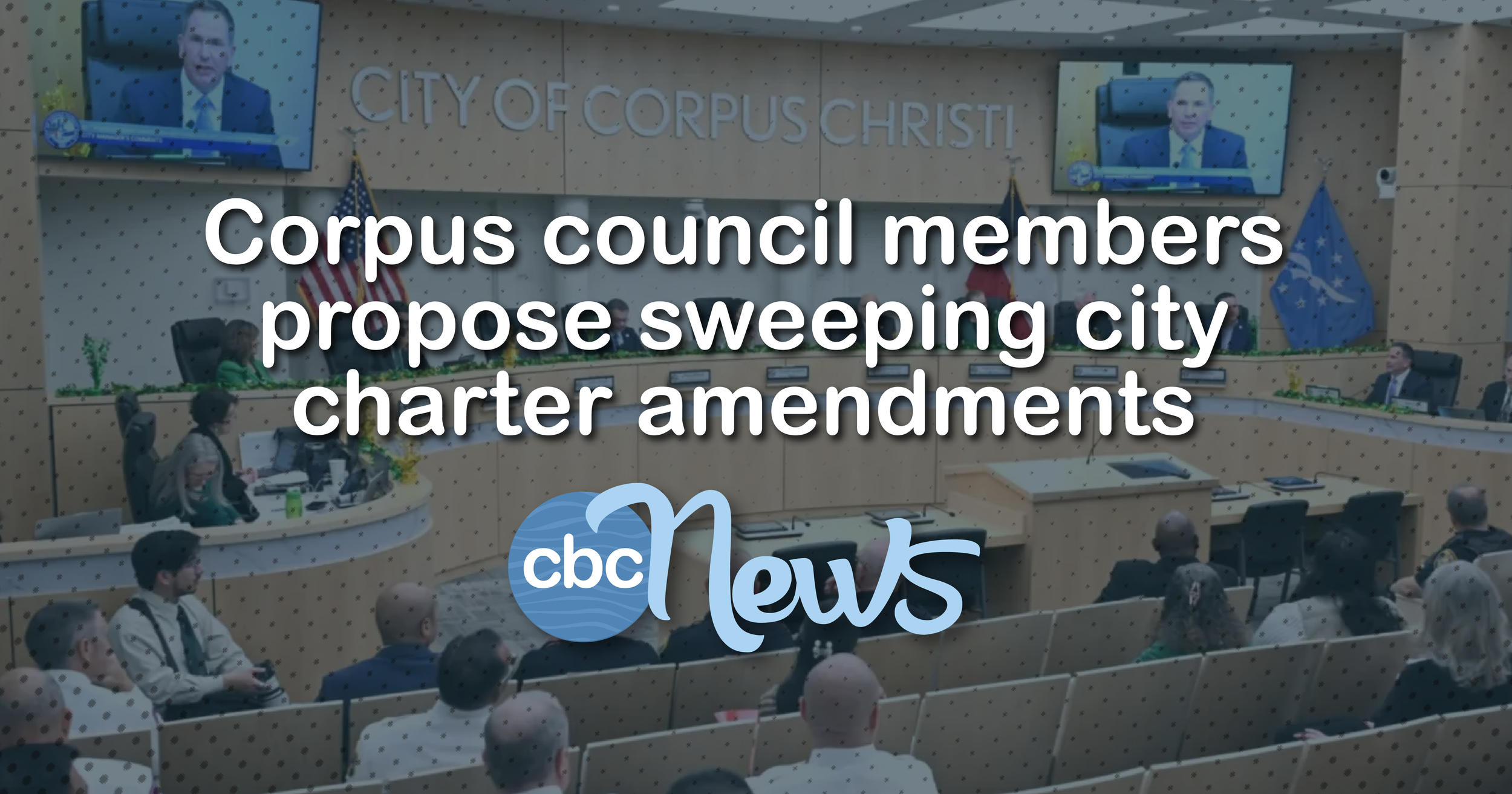
Three Corpus Christi City Council members have proposed a sweeping package of city charter amendments, setting up the possibility that at least five separate ballot propositions could go before local voters this November.
At next Tuesday’s meeting, Carolyn Vaughn, Kaylynn Paxson and Gil Hernandez will ask the full council to consider an ordinance placing ten distinct charter changes on the ballot, grouped into four propositions covering council terms and structure, elected officials' pay, the process for removing a council member, and a dedicated property tax increase for street repair.
The move comes as the citizen-initiated Fair Water Amendment, another proposed charter change that would eliminate Corpus Christi’s industrial drought surcharge exemption fee, also appears on the July 21st council meeting agenda for discussion in executive session. The council must vote by mid-August to finalize all items for the November ballot.
The trio’s first and most extensive proposition would restructure how the council is elected and how long members serve. Council terms would grow from two years to four years, and the three at-large seats would be split off from the mayor's and district members' election cycles so that terms are staggered rather than all expiring at once.
Under a draft transition plan, the mayor and the reconstituted at-large seats would move to four-year terms starting with the November 2028 election, while the five single-member district seats would continue on two-year terms until November 2030, when they would also shift to four years. After that, the mayor and at-large seats would be elected in one cycle and the district seats in the next.
The proposition would also replace the current method of electing the three at-large council members. Currently all three at-large seats are decided in a single race in which candidates run against the full field. A candidate can win with as little as 12 percent of the vote, with runoff rules that vary depending on how many candidates clear that threshold. The proposed amendment would instead create three separate, numbered at-large seats, each elected in a dedicated race with victory requiring a majority vote, with a standard two-candidate runoff if no one clears 50 percent.
Term limits would also change. Under the current rules, a person may serve up to four consecutive two-year terms in a single office, or up to six consecutive two-year terms across combined offices, meaning a maximum of eight years in one seat or twelve years across multiple offices. The proposal instead caps consecutive service at three four-year terms, or twelve years total, in any combination of mayor, at-large or district seats, with a four-year period required to pass before a term-limited official could run again.
The proposal also spells out more clearly how a mayoral vacancy gets filled. Today, if the mayor's seat becomes vacant, the top vote-getting at-large council member steps into the role, unless more than a year remains in the term, in which case a special election is called. The proposal preserves the same basic setup, using twelve months as the cutoff, but adds a requirement that the council call and hold any special election within 120 days.
A similar rule applies to vacancies in other council seats. Today, the remaining council members simply appoint a replacement, regardless of how much time is left in the term. Under the proposal, appointment would still be used to fill two-year-term seats, while they remain, and any seat with twelve months or less remaining. But a four-year-term seat with more than twelve months left would instead go to a special election to be held within 120 days.
The second proposition addresses council pay. Members currently receive a flat $6,000 per year, with the mayor receiving $9,000. The amendment would instead set members' annual salary equal to 2,080 hours, a full-time work year, multiplied by the federal minimum hourly wage in effect each January 1. At the current minimum wage of $7.25 an hour, that formula would produce an annual council salary of $15,080, about two and a half times the current amount. The mayor's salary would be set at 125 percent of the council salary, or about $18,850.
The third proposition would make it harder to remove a sitting council member from office. Under the current charter, a removal proceeding can be triggered by a petition signed by five voters, and a member can be removed by a simple majority vote of the council. The proposed amendment would raise the petition threshold to a number of voters equal to one-half of one percent of votes cast in the most recent election for that office, a substantially higher bar. It would also raise the vote required for removal from a simple majority to two-thirds of council members, excluding the member facing removal.
The fourth proposition would authorize the council to adopt a property tax rate that is two cents higher, per $100 of taxable value, than the rate adopted the prior year, contingent on that increase being allowed under the Texas tax code. Revenue generated by the two-cent increase would be dedicated exclusively to the construction, maintenance, repair, rehabilitation and reconstruction of public streets and roadway infrastructure within the city, and could not be redirected to other purposes without another charter change.
Taken together, the propositions by Vaughn, Paxson and Hernandez touch nearly every structural aspect of city governance covered by the charter: how long council members serve, how their terms are staggered, how at-large seats are elected, how vacancies are filled, what elected officials are paid, the process for removing a member, and how much residents pay in property taxes for street maintenance. The Current will continue to report on developments.